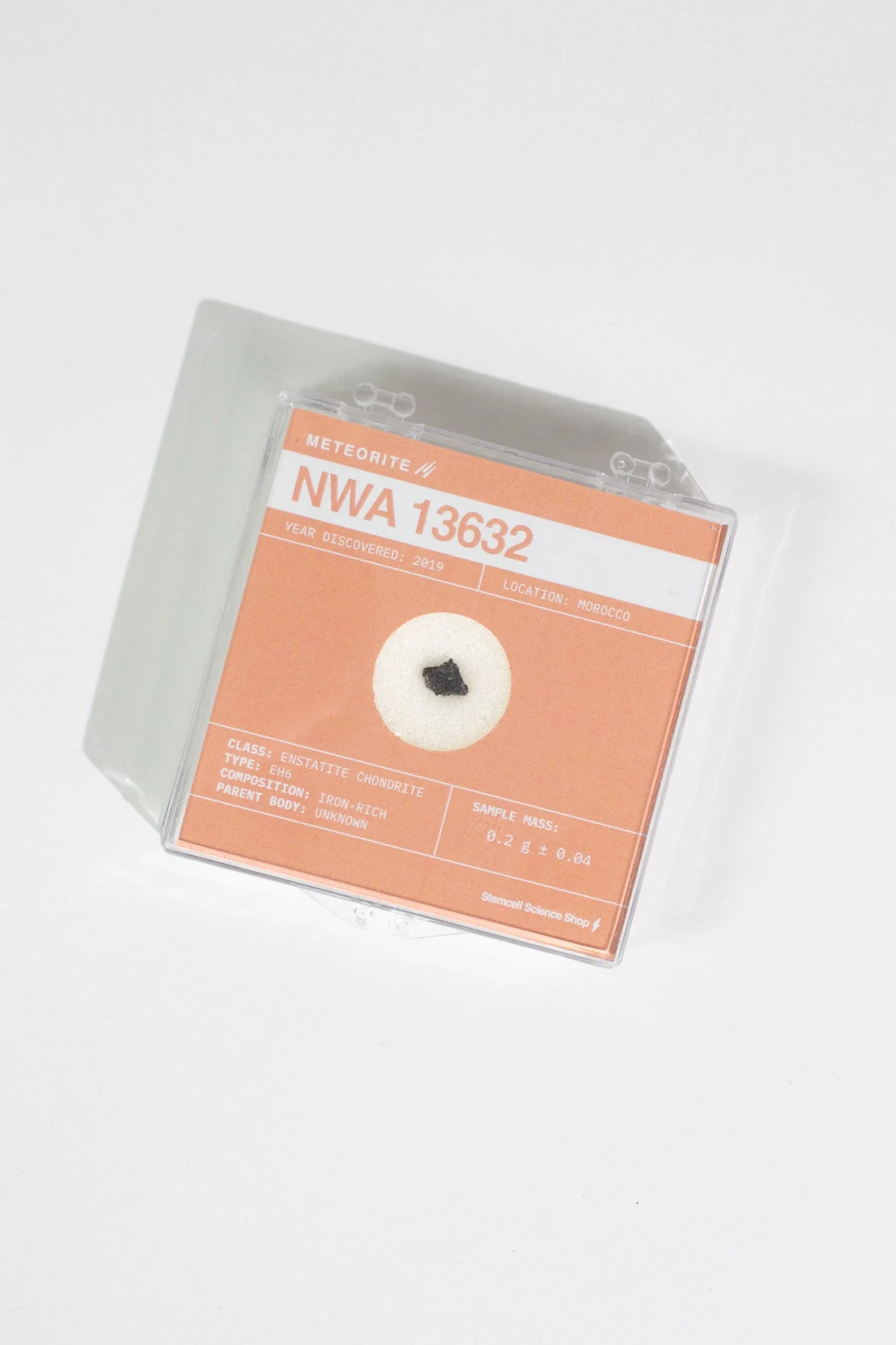
Fragment of the Early Solar System - NWA 13632
Meteorite NWA 13632 belongs to the rare E-type group of meteorites, thought to have formed during the early stages of the solar system 4.5 billion years ago.
Enstatite meteorites are characterized by a distinct metallic composition that aligns with the material present in the inner regions of the protoplanetary disk, where most other substances were scarce or vaporized. High levels of enstatite (MgSiO3), a high-temperature silicate mineral, along with the unique oxygen isotopic signatures of E-type meteorites strongly support this origin.
Some evidence suggests these meteorites may have fragmented from the asteroid Psyche, one of the most massive asteroids in the solar system. After fragmentation, the smaller bodies could have intercepted Earth’s orbit. A spacecraft named after Psyche is currently en route to study the metallic world.
Studying enstatite meteorites helps refine our models of planetary formation and differentiation. Their rarity and distinct characteristics make them crucial pieces of the cosmic puzzle, shedding light on the conditions, processes, and materials that shaped our solar system billions of years ago.
Includes a fragment of IMCA-verified enstatite meteorite NWA13632 in an acrylic display case with certificate of authenticity.
Meteorite NWA 13632 belongs to the rare E-type group of meteorites, thought to have formed during the early stages of the solar system 4.5 billion years ago.
Enstatite meteorites are characterized by a distinct metallic composition that aligns with the material present in the inner regions of the protoplanetary disk, where most other substances were scarce or vaporized. High levels of enstatite (MgSiO3), a high-temperature silicate mineral, along with the unique oxygen isotopic signatures of E-type meteorites strongly support this origin.
Some evidence suggests these meteorites may have fragmented from the asteroid Psyche, one of the most massive asteroids in the solar system. After fragmentation, the smaller bodies could have intercepted Earth’s orbit. A spacecraft named after Psyche is currently en route to study the metallic world.
Studying enstatite meteorites helps refine our models of planetary formation and differentiation. Their rarity and distinct characteristics make them crucial pieces of the cosmic puzzle, shedding light on the conditions, processes, and materials that shaped our solar system billions of years ago.
Includes a fragment of IMCA-verified enstatite meteorite NWA13632 in an acrylic display case with certificate of authenticity.
Original: $26.00
-65%$26.00
$9.10Description
Meteorite NWA 13632 belongs to the rare E-type group of meteorites, thought to have formed during the early stages of the solar system 4.5 billion years ago.
Enstatite meteorites are characterized by a distinct metallic composition that aligns with the material present in the inner regions of the protoplanetary disk, where most other substances were scarce or vaporized. High levels of enstatite (MgSiO3), a high-temperature silicate mineral, along with the unique oxygen isotopic signatures of E-type meteorites strongly support this origin.
Some evidence suggests these meteorites may have fragmented from the asteroid Psyche, one of the most massive asteroids in the solar system. After fragmentation, the smaller bodies could have intercepted Earth’s orbit. A spacecraft named after Psyche is currently en route to study the metallic world.
Studying enstatite meteorites helps refine our models of planetary formation and differentiation. Their rarity and distinct characteristics make them crucial pieces of the cosmic puzzle, shedding light on the conditions, processes, and materials that shaped our solar system billions of years ago.
Includes a fragment of IMCA-verified enstatite meteorite NWA13632 in an acrylic display case with certificate of authenticity.